Synthetic agents are easier to manipulate in experiments than humans
August 27, 2026
Digital twins are less diverse than the underlying humans they seek to replicate. This reduced variability can cause in silico studies to show a massive impact from a tiny treatment that fails to hold on actual people.
A great paper led by Joon Sung Park, founder of Simile, used LLM-generated "humans" to replicate several social science experiments. They gathered a group of people and ran five experiments on them, all about what they would do in hypothetical situations. First, they created synthetic versions of these subjects through semi-structured interviews, surveys, and demographic data collection. Then they fed some combination of this information (i.e., interview only, interview + survey, demographic only, etc.) to an LLM and ran the same experiments on the synthetic humans. The table below shows the results.
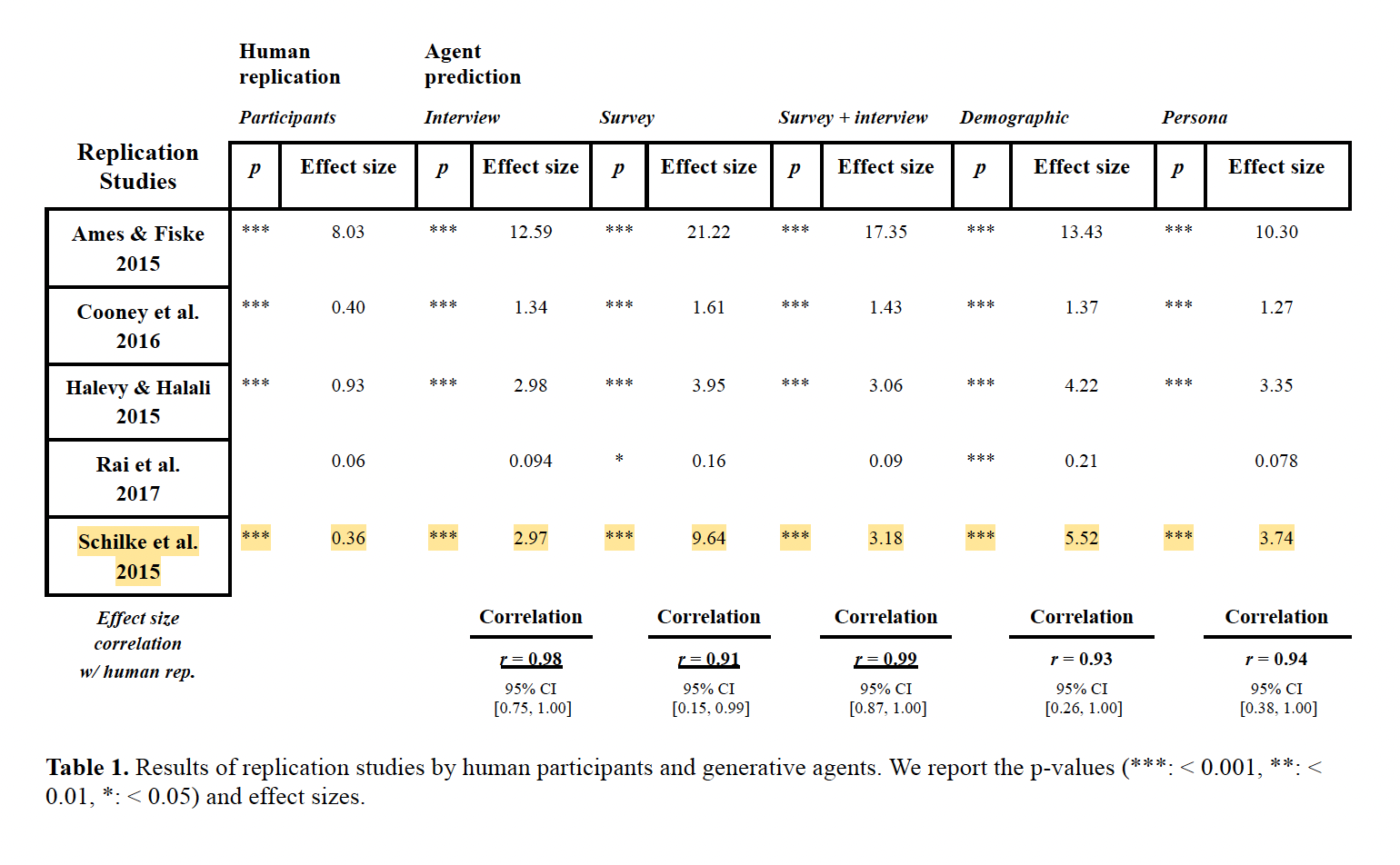
The treatments typically had a small to modest but statistically significant effect on the humans and a massive effect on the agents.
To illustrate, the Schilke et al. 2015 study (last row, highlighted) tests how power affects trust. They had two groups imagine themselves as typists. A "high power" group imagined they were providing important services for extra spending money while a "low power" group imagined they were providing a non-essential service for money needed to pay the bills. The researchers measured trust by whether participants would provide a free sample of their typing service to a potential client and found that the high power group was less likely to provide a sample.
The humans in the Park et al. study replicated this effect, finding the low power group was slightly more likely to provide a sample than the high power group (Cohen's d = 0.36). But the treatment massively impacted the agents: even the smallest effect size, for the interview-only agent (Cohen's d = 2.97), was roughly 8x the human one.
Cohen's d alone can't recover the exact proportions who offered a sample in each group. But with values this large, we can bound them. For instance, if nobody in the high power group offered a sample, then 81.5 percent of the low power group must have offered a sample to reach d = 2.97.1 This means 81.5 percent is the smallest possible proportion of the low power group that offered a sample.
The table below shows hypothetical proportions of the low power group who offered a sample and the corresponding proportions from the high power humans and agents.
| Offered a sample (low power) | High power humans (d = 0.36) | High power interview agents (d = 2.97) |
|---|---|---|
| 10% | 1.7% | no solution (max |d| = 0.47) |
| 30% | 15.2% | no solution (max |d| = 0.93) |
| 50% | 32.6% | no solution (max |d| = 1.41) |
| 85% | 70.2% | 2.7% |
| 90% | 76.8% | 7.1% |
| 95% | 84.2% | 12.3% |
| 99% | 91.4% | 17.1% |
For the humans, we don't know what proportion of each group offered a sample, but whatever the proportion, the human subjects mostly did the same thing. A predictive model with just this treatment would struggle. But for agents, the treatment effect was massive, almost deterministic. Studies performed in silico may not travel well to the humans we ultimately care about.
Footnotes
-
We use and solve for given fixed values of . ↩